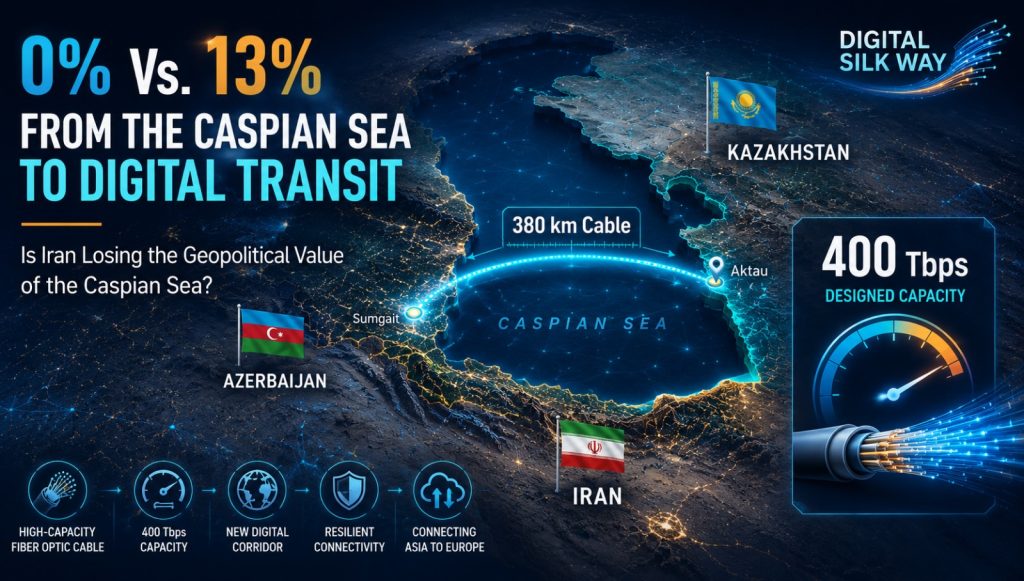
From 13% of the Caspian Sea to 0% of Digital Transit: Is Iran Losing the Geopolitical Value of the Caspian Sea?
The Caspian Sea is entering a new phase of geopolitical competition; a competition that is no longer limited to oil and gas, ports, transportation corridors, and subsea resources. Alongside these traditional strategic assets, a new and increasingly important asset is emerging: data transmission capacity. Submarine fiber-optic cables, data centers, international IP routes, Internet gateways, transmission networks, and redundant connectivity paths are becoming components of national strategic power. From this perspective, the successful installation of the Trans-Caspian Fiber Optic Cable between Azerbaijan and Kazakhstan cannot be viewed merely as a technical announcement about a 380-kilometer submarine cable. It is part of a broader transformation of Eurasia’s connectivity architecture and could have long-term implications for Iran’s position in the regional digital value chain.
For years, much of the public debate surrounding Iran’s position in the Caspian Sea has focused on one question: What percentage of the Caspian Sea belongs to Iran? Figures such as 20%, 13%, and other percentages have frequently appeared in media discussions. In some cases, these figures have been presented as though a specific agreement definitively reduced Iran’s share from 20% to 13%. Such an interpretation is not legally accurate. The Convention on the Legal Status of the Caspian Sea, signed in Aktau on August 12, 2018, established a legal framework governing the use of the waters, seabed, subsoil, resources, security, and various maritime activities, but it did not establish a final percentage-based division of the Caspian Sea among the five littoral states.
The origin of the 13% figure is connected to the long-standing dispute over delimitation methodology. Iran has historically supported an equal 20% share for each of the five littoral states, while approaches based on coastline length and various delimitation methods could result in a substantially smaller Iranian share, often estimated at around 13%. Therefore, 13% should be understood as a possible outcome or estimate under a particular delimitation methodology rather than as a final percentage formally transferred away from Iran. Legal and analytical studies have also emphasized that the 2018 Convention left important aspects of seabed and subsoil delimitation to subsequent agreements between the relevant states.
However, if we move beyond the legal debate and look at the Caspian Sea from an information and communications technology perspective, a much more important issue emerges. The debate over Iran’s exact percentage of the Caspian Sea may continue for years, while other countries are simultaneously developing infrastructure that can capture the economic and strategic value of the Caspian without requiring Iran to be part of the core architecture. This is where the concept of geographical share becomes distinct from economic and digital share.
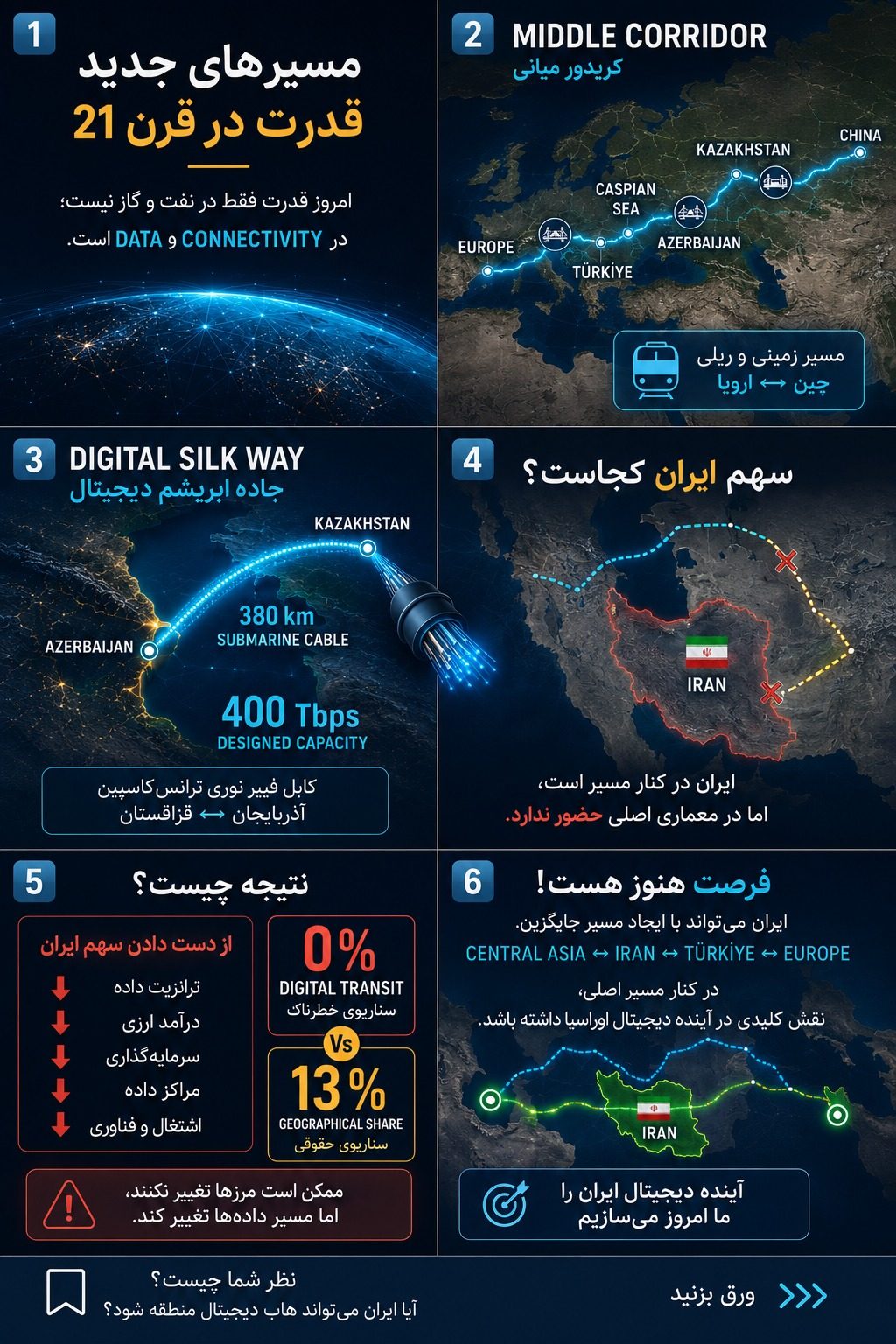
The successful installation of the Trans-Caspian Fiber Optic Cable is significant precisely because of this distinction. The project involves a submarine fiber-optic connection of approximately 380 kilometers between Sumgait in Azerbaijan and Aktau in Kazakhstan, with a designed capacity of more than 400 Tbps across 32 fiber pairs. Telecom Review has described the cable as a key component of the Digital Silk Way project, which aims to establish a communications corridor connecting Central Asia with Europe through Azerbaijan, Georgia, and Türkiye.
The technical significance of this project lies not only in its capacity, but in its topology. A submarine cable creates real strategic value when it is connected at both ends to high-capacity terrestrial networks, data centers, international carriers, Internet Exchange Points, and multiple international routes. In other words, a 400 Tbps submarine cable by itself does not create a Digital Corridor. It must become part of a larger connectivity ecosystem. Nevertheless, its installation creates a critical link between Central Asia and the Caucasus, providing a new high-capacity route toward Europe.
At its simplest level, the architecture can be represented as:
Central Asia → Kazakhstan → Caspian Sea → Azerbaijan → Georgia → Türkiye → Europe
From a telecom perspective, this route is highly significant because it creates an alternative path for traffic between Asia and Europe. The Digital Silk Way is therefore not simply an attempt to connect two countries; it is an attempt to create a broader network of networks, combining terrestrial and submarine infrastructure. Telecom Review has emphasized that the Trans-Caspian cable provides a critical link for connecting Central Asia, and ultimately Asian traffic, with European routes.
This is where the project becomes strategically important for Iran.
The cable runs between Kazakhstan and Azerbaijan, not between Kazakhstan and Iran. This means that the countries involved in the project do not need to cross Iranian territory or rely on Iran’s international network to establish this new digital connection. This does not mean that Iran has lost any legal rights over the Caspian Sea, nor should it be interpreted in that way. However, from a digital-geopolitical perspective, it demonstrates that a strategically important connectivity corridor is being developed immediately north of Iran without Iran being part of its primary architecture.
That distinction is critical.
A country can be geographically adjacent to a corridor without actually being part of the corridor. In telecommunications, this difference can have significant economic consequences. Revenues associated with international transit, fiber capacity, cross-border connectivity, colocation, data centers, peering, cloud connectivity, and network security generally flow toward countries that are part of the actual traffic path, not simply those located geographically close to it.
To understand this more clearly, it is useful to compare digital transit with traditional transportation transit. In a conventional trade corridor, a country located along the route can generate economic value through ports, railways, roads, warehouses, insurance, logistics, and customs services. In a Digital Corridor, a country located along the data path can generate value through fiber capacity, IP transit, data centers, cloud connectivity, CDN infrastructure, Internet Exchange Points, colocation, and cybersecurity services.
This is why the Trans-Caspian cable should be viewed as part of a Digital Infrastructure Corridor, rather than simply as another telecommunications cable.
This is also where its connection to the debate over Iran’s share of the Caspian becomes meaningful.
Even if we consider 13% as a possible geographical or legal scenario, the more important question is what economic value Iran can create from its geographical position. Geographic access without infrastructure does not automatically create Digital Power. Just as natural resources do not necessarily generate wealth without extraction and a complete value chain, a favorable geographic position does not automatically turn a country into a transit hub.
Azerbaijan, by contrast, is actively converting its geographical position into a digital asset. Sumgait forms one endpoint of the cable, while Aktau forms the other. Azerbaijan’s terrestrial networks can then connect this infrastructure toward Georgia and Türkiye, while Kazakhstan can connect it to Central Asian networks and routes extending toward Asia.
The geography of the Caspian is therefore becoming part of a data path.
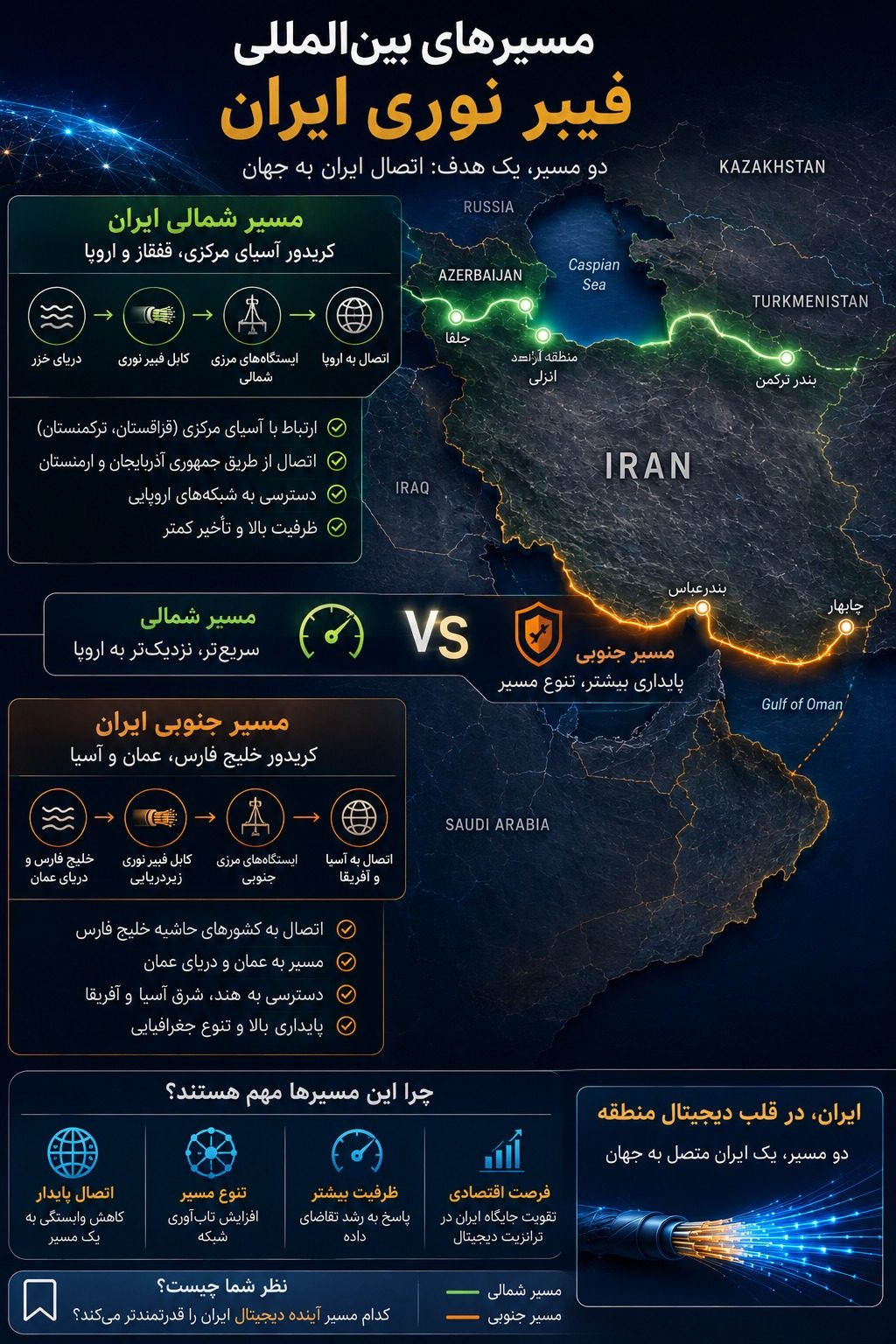
This is particularly important for Iran because Iran also has the geographical potential to establish an alternative or complementary route. Iran is located on the southern shore of the Caspian Sea and simultaneously has access to Türkiye, the Persian Gulf, the Gulf of Oman, and Central Asia. Therefore, one potential route could be:
Central Asia → Caspian → Iran → Türkiye → Europe
Another could be:
Central Asia → Iran → Persian Gulf → India / Asia
These routes could potentially form part of an Alternative Digital Corridor.
آیا ایران میتواند به یک Digital Transit Hub تبدیل شود؟
For Iran to become a genuine Digital Transit Hub, it would need to develop or significantly strengthen a set of interconnected infrastructures. The first is an International Fiber Backbone. The domestic network must be capable of transporting large volumes of international traffic from landing points to major data centers, international gateways, and terrestrial borders. Such a network needs multiple routes, high capacity, and sufficient redundancy.
The second component is the International Gateway. A country may have thousands of kilometers of fiber, but if its international gateways, international capacity, and carrier interconnections are limited, it cannot become a meaningful transit provider.
The third component is a Submarine Cable Landing Station. If Iran wants to capitalize on its Caspian position, the northern coastline must be viewed not simply as a traditional maritime infrastructure zone but as a potential digital infrastructure zone. A landing station is not merely the point where a cable reaches the shore. It needs power systems, physical security, optical transport equipment, monitoring, cross-connect facilities, terrestrial backhaul, and ultimately connectivity to data centers and international networks.
The fourth component is a Carrier-Neutral Data Center. International traffic becomes significantly more valuable when operators, cloud providers, CDN companies, major Internet networks, and enterprises can interconnect in the same location. Therefore, a submarine cable without a broader data-center ecosystem may fail to capture a substantial portion of its potential economic value.
The fifth component is an Internet Exchange Point (IXP). A strong IXP can allow traffic to be exchanged locally or regionally rather than unnecessarily traversing distant international routes. This can reduce latency, lower transport costs, and increase the attractiveness of a geographic location to network operators and content providers.
The sixth component is Cloud Connectivity. Modern international connectivity is no longer limited to conventional web traffic. Cloud computing, SaaS, AI workloads, CDN services, streaming, enterprise connectivity, and IoT will account for an increasing share of global traffic. A country seeking to become a Digital Corridor must therefore establish strong connectivity to regional and international cloud and data-center ecosystems.
The seventh component is security. As an international route becomes more strategically important, cybersecurity, DDoS protection, traffic scrubbing, threat intelligence, physical security, and resilience become increasingly important. A Digital Corridor must be able to withstand cable cuts, cyberattacks, human error, equipment failures, and other infrastructure disruptions.
Consequently, the real question for Iran is not whether it could technically bring a submarine cable from the Caspian Sea into Iran. From an engineering perspective, such a project is entirely feasible. The real question is whether Iran can build a commercially viable Digital Corridor that international carriers and technology companies would actually want to use.
That is a much more complex issue.
International carriers do not select routes solely on the basis of fiber price. They evaluate latency, availability, SLA performance, MTTR, path diversity, political risk, regulatory conditions, security, interconnection opportunities, and access to alternative routes. Therefore, if Iran wants to compete with the Trans-Caspian route, it must offer a genuine value proposition.
One potential advantage for Iran is route diversity. In international networks, redundancy has economic value. Major carriers do not want to place all of their connectivity on a single route. If multiple routes exist between Central Asia and Europe, operators can use them for business continuity, disaster recovery, and network resilience.
From this perspective, even if the Azerbaijan–Georgia–Türkiye corridor becomes highly successful, an Iran–Türkiye route could still retain strategic value because it would not necessarily need to compete directly with the primary route. It could serve as an alternative route and provide additional path diversity.
This is where geopolitics becomes an important factor.
International telecom routes are heavily influenced by political and regulatory risk. Sanctions, restrictions on equipment access, financial limitations, international carrier relationships, foreign investment, regulatory requirements, and the ability of global operators to establish commercial agreements with Iranian networks all influence route selection.
Iran may therefore have a geographically attractive route, but if the commercial risk associated with that route is considered too high, international carriers may select a longer but more predictable alternative.
This is one reason geography alone does not determine the final architecture of the Digital Silk Road.
Azerbaijan is attempting to position itself as a Digital Gateway between Central Asia and Europe. Kazakhstan is leveraging its Central Asian geography to connect western routes with Asian networks. Türkiye, because of its location between Asia and Europe, is already one of the region’s important interconnection points.
A new chain is therefore emerging:
Central Asia → Caspian → Caucasus → Türkiye → Europe
And this chain is being developed not only for the movement of goods, but increasingly for the movement of data.
This is where the Middle Corridor and the Digital Silk Way become interconnected.
Traditional corridors rely on roads, railways, ports, and logistics infrastructure. Digital corridors rely on fiber, data centers, gateways, submarine cable landing stations, and interconnection facilities. As the digital economy expands, these infrastructures will become increasingly strategic.
Therefore, if Iran focuses exclusively on defending its geographical position in the Caspian while failing to develop its digital infrastructure, it could lose part of the economic value of the Caspian without necessarily losing a single kilometer of territory or legally recognized maritime rights.
This distinction needs to be clearly understood.
Losing economic relevance is not the same as losing sovereignty.
Borders can remain unchanged while the direction of capital, goods, and data changes.
This is precisely what has happened in many global transportation and communications corridors. A country may possess an excellent geographical position, but if another country develops a faster, safer, cheaper, or commercially more attractive infrastructure route, economic flows may move elsewhere.
In telecommunications, this effect can be even stronger because investments in submarine cables and terrestrial fiber can shape international traffic architecture for decades.
The Trans-Caspian cable should therefore be viewed from this perspective. When a submarine cable with a designed capacity exceeding 400 Tbps is installed, the objective is not simply to meet current demand. Such infrastructure is designed to support long-term traffic growth and can remain a strategic asset in the international network architecture for many years. Telecom Review has reported a capacity of more than 400 Tbps across 32 fiber pairs and indicated that full operational deployment is targeted for the end of 2026.
From a technical perspective, however, it is important to distinguish between installed capacity and utilized capacity. A designed capacity of 400 Tbps does not mean that all 400 Tbps will be activated, sold, or used on day one. Commercial success depends on terrestrial connectivity, optical transmission systems, carrier agreements, backhaul capacity, international interconnection, and anchor customers. Therefore, 400 Tbps should be viewed as the potential infrastructure capacity rather than the volume of actual traffic currently flowing through the cable.
Nevertheless, the strategic message remains significant: countries around the Caspian are actively investing in the digital value of the sea.
Iran could adopt the same approach.
But the problem is that, in telecommunications, being geographically located on a map is not enough.
Hamid Karimi
The Caspian coastline could become part of a Northern Digital Gateway for Iran. In such a model, high-capacity fiber would connect northern landing points to the country’s major network hubs and then connect through multiple routes to Türkiye, Central Asia, Iraq, and the southern regions of the country. Such an architecture could create a regional mesh in which Iran is not merely a consumer of international connectivity but also a potential regional transit provider.
This requires a shift from National Connectivity to Regional Connectivity.
In the traditional model, the primary objective of Iran’s international telecommunications network is to serve domestic users and operators. In a regional transit model, the objective is expanded: Iran would also seek to attract foreign traffic and transport it between different countries.
These two models are fundamentally different from both an architectural and business perspective.
Transit requires high-capacity optical transport, international-grade SLAs, redundant networks, wholesale connectivity agreements, international PoPs, peering, security infrastructure, and carrier-grade data centers.
Latency must also be evaluated against competing regional routes. If an Iranian route can offer lower latency for certain origin-destination pairs, greater path diversity, or better resilience, those characteristics can become commercial advantages.
This is also where AI enters the picture.
The next generation of international networks will not simply consist of passive fiber infrastructure. Traffic engineering, capacity planning, predictive maintenance, optical performance monitoring, anomaly detection, and cybersecurity analytics will increasingly depend on AI. A country that seeks to operate as a Digital Transit Hub will need to prepare its network for this new generation of operations.
Autonomous Networks, AIOps, and predictive analytics can play a significant role in such infrastructure. An international route capable of dynamically managing capacity, predicting failures, rerouting traffic, and continuously monitoring SLA compliance can provide significantly greater commercial value than a conventional fiber route.
Thus, the Caspian discussion is indirectly connected to the same transformation taking place throughout the telecommunications industry under concepts such as Autonomous Networks, AI-Native Networks, and Intent-Based Networking.
In this emerging environment, the question is no longer simply:
Who owns how much of the Caspian Sea?
A more strategic question is:
Who will turn the Caspian Sea into digital infrastructure?
The answer could have a greater economic impact over the next decade than the percentage of geographical allocation itself.
If Azerbaijan and Kazakhstan successfully integrate the Trans-Caspian cable with their terrestrial networks and turn it into a commercially successful corridor, the strategic value of their Caspian positions will increase. If Georgia and Türkiye provide the necessary capacity toward Europe, a complete digital chain will emerge.
In such a scenario, Iran has three broad choices.
The first is non-participation. In this case, Iran would remain geographically adjacent to a major digital corridor while the primary traffic flows through another route.
The second is limited connectivity, in which Iran connects to the wider ecosystem and participates through selected interconnections or terrestrial routes.
The third, and strategically more attractive option, is the creation of a parallel Digital Corridor capable of connecting Central Asia through Iran to Türkiye and Europe, while also providing connectivity southward toward the Persian Gulf, India, and Asian markets.
The third scenario requires significantly greater investment, but if successfully implemented, it could multiply the strategic value of Iran’s geographical position.
Under this model, the Caspian Sea would no longer be viewed merely as a maritime area, a fishing zone, or an energy resource. It could become a Digital Entry Point for Iran.
This shift in perspective is critical.
In the digital economy, fiber optics can be viewed as a form of data pipeline. Just as energy pipelines can shape geopolitical relationships and economic corridors, fiber routes can reshape digital geography. The difference is that data moves at extremely high speed and can carry enormous volumes of economic activity.
This is why the installation of the Trans-Caspian cable should be seen as a signal for Iranian policymakers and telecommunications executives.
The signal is clear: competition over the future of the Caspian is no longer limited to natural resources.
Competition over connectivity has begun.
Consequently, even if the legal debate over Iran’s share of the Caspian is set aside, a purely technical and economic question remains:
Can Iran convert its geographical position into digital value?
The answer depends on several factors: international fiber development, submarine cable landing infrastructure, transmission capacity, data-center development, strong IXPs, international carrier participation, redundant routes, wholesale connectivity frameworks, and a predictable commercial and regulatory environment.
If these conditions are established, Iran does not necessarily need to compete directly with the Azerbaijan–Kazakhstan Trans-Caspian project. It could become part of a larger architecture in which multiple parallel routes coexist.
In fact, the most resilient regional architecture is not necessarily based on a single corridor. The global Internet depends on route diversity. The greater the Path Diversity, the greater the resilience.
An Iranian route could therefore complement the Trans-Caspian route.
Kazakhstan → Azerbaijan → Georgia → Türkiye → Europe
could coexist with:
Central Asia → Iran → Türkiye → Europe
while:
Iran → Persian Gulf → India / Asia
could create another international route.
Under such an architecture, Iran could become an interconnection point between multiple geographical regions.
But if this opportunity is missed, a very different outcome could emerge. Other countries will continue developing their fiber routes, data centers, international gateways, and carrier ecosystems. Once those ecosystems reach sufficient scale, establishing a competing route becomes more difficult and expensive. Digital ecosystems, like transportation networks, benefit from network effects. The larger a connectivity hub becomes, the easier it is for it to attract additional carriers, data centers, cloud providers, content networks, and customers.
This is why timing matters.
The Trans-Caspian cable does not mean that Iran’s opportunity has disappeared. On the contrary, it can serve as a wake-up call.
Iran still has the potential to leverage its position on the southern Caspian, its access to Türkiye, the Persian Gulf, the Gulf of Oman, and Central Asia. But achieving this requires a fundamental change in how telecommunications is viewed: from simply delivering Internet services to Iranian subscribers toward delivering regional connectivity.
This transformation from Telecom Operator to Digital Infrastructure Provider will be one of the most important developments in telecommunications in the coming years.
Under this model, a telecom operator is no longer simply a provider of voice, data, or SIM cards. It can become an infrastructure provider for fiber, international capacity, cloud connectivity, data centers, security, and wholesale transit.
This is precisely where the debate over the Caspian Sea and the Trans-Caspian cable converge.
The figure of 13%, when discussed as a possible delimitation scenario, is a legal and geographical concept. But zero percent of digital transit is an economic warning—not a claim that Iran literally carries zero regional traffic, but a strategic scenario illustrating the risk that Iran could have no direct role in a new regional digital corridor.
Therefore, the title “From 13% of the Caspian Sea to 0% of Digital Transit” should be understood as a strategic metaphor rather than a literal statistical claim.
Iran may retain recognized rights and a defined geographical position in the Caspian Sea, but if it fails to capture a meaningful share of the value created by the Digital Silk Way and the emerging Caspian connectivity infrastructure, it could lose part of the geopolitical value of its geographical position.
Ultimately, the key issue is no longer only where the maritime boundaries of the Caspian Sea are drawn.
The more important question is:
Where will the fiber-optic lines of the future be drawn?
In the twentieth century, the geography of power around the Caspian was shaped by oil, gas, ports, pipelines, and energy corridors. In the twenty-first century, a new layer is being added: Data Geography.
The 380-kilometer connection between Aktau and Sumgait, with a designed capacity exceeding 400 Tbps, is a clear example of this transformation. The cable alone will not determine the future digital geography of the Caspian, but it demonstrates that regional countries are no longer waiting for the digital value of the Caspian to emerge naturally. They are actively building it.
For Iran, this development should be viewed not merely as an Azerbaijani or Kazakh telecommunications project, but as a Regional Telecom Development Signal.
If Iran can convert its geographical position into digital infrastructure, the Caspian Sea could become one of the country’s gateways to Central Asia and Europe.
If it cannot, Iran may find itself in a situation where, geographically, it sits beside one of Eurasia’s most important emerging connectivity zones, while a significant portion of the region’s data traffic flows north of it.
At that point, the most important question will no longer be:
How much of the Caspian Sea belongs to Iran?
It will be:
Why does a country with such a strategic geographical position have no proportionate share of the Fiber, Data Center, International Connectivity, and Transit value created by the Digital Silk Road?
And that may become one of the most important telecommunications questions facing Iran as the digital geography of the Caspian Sea begins to change.
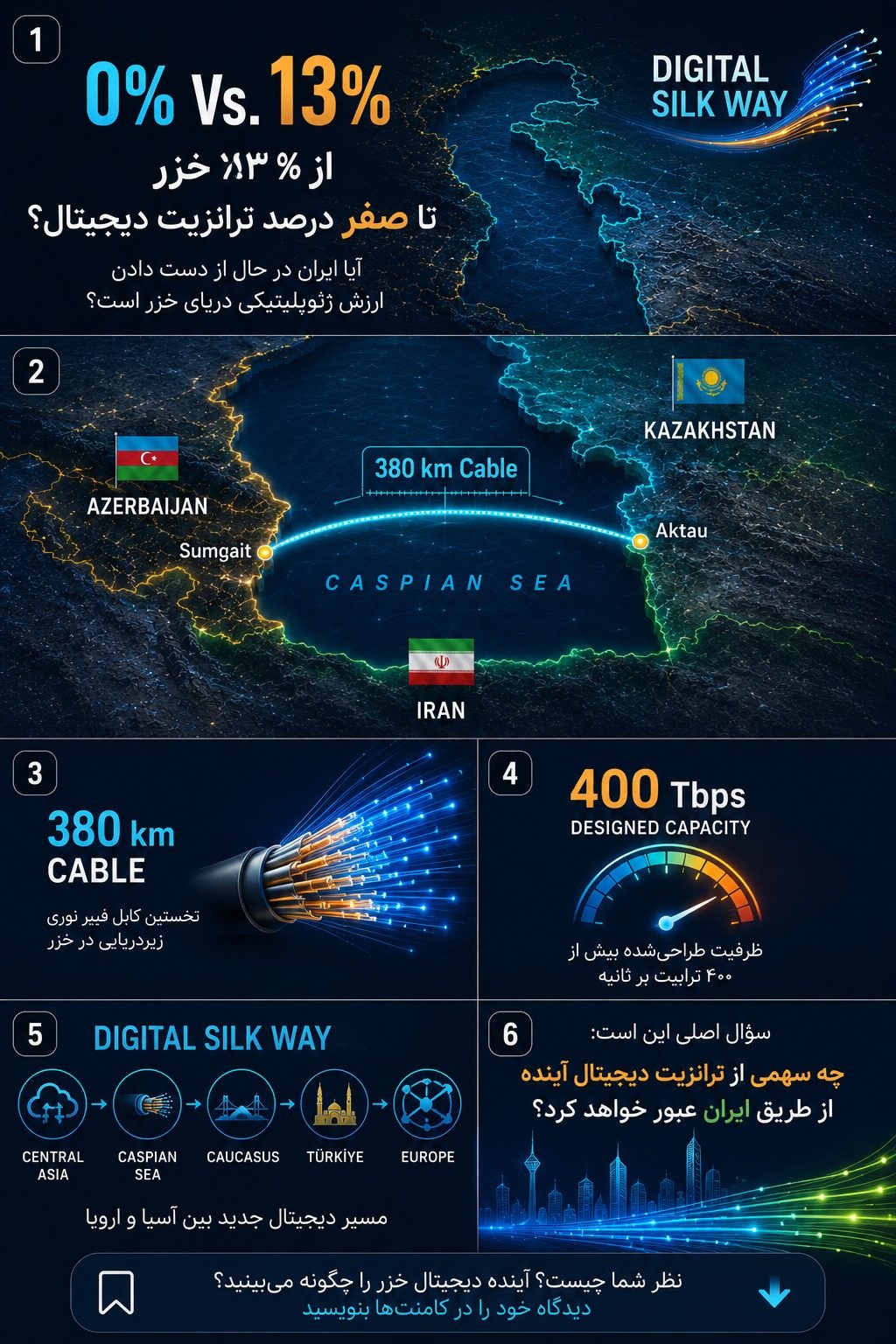
از ۱۳٪ خزر تا صفر درصد ترانزیت دیجیتال؛ آیا ایران در حال از دست دادن یک فرصت ژئوپلیتیکی است؟
Read More