
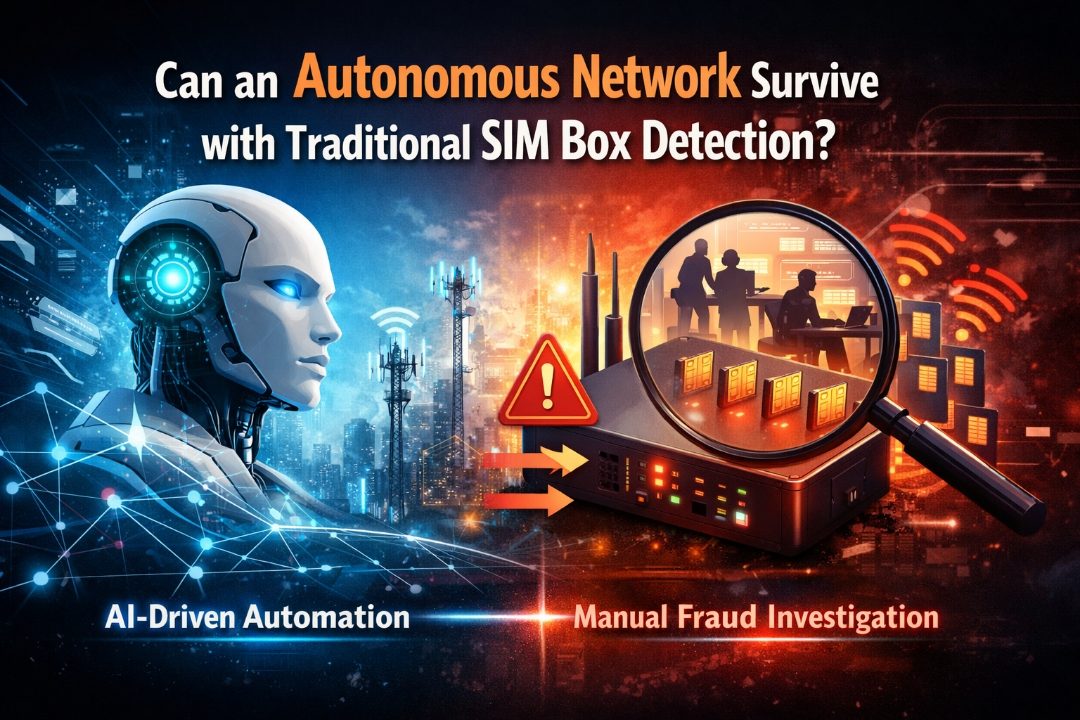
Can an Autonomous Network Survive with Traditional SIM Box Detection?
The telecom industry is moving toward Autonomous Networks.
Networks that can optimize themselves.
Heal themselves.
Scale themselves.
And increasingly, make decisions without human intervention.
But there is an important question that often gets overlooked:
Can a network truly be autonomous if its fraud management still depends on manual investigations?
Consider a typical SIM Box fraud scenario.
A fraud detection platform identifies suspicious behavior.
An alert is generated.
An analyst reviews the case.
Evidence is collected.
A decision is made.
SIMs are blocked.
Hours pass.
Sometimes days.
The reality is that the concept of network autonomy is incomplete without autonomy in the areas of security and fraud management. A network that can detect equipment failure but cannot respond quickly to a fraudulent attack is still a long way from the true concept of an Autonomous Network.
Hamid Karimi
Meanwhile, the fraud operation continues generating revenue losses and adapting its behavior.
Now compare that process to the vision of an autonomous network.
Traffic anomalies are detected in real time.
Behavioral intelligence identifies coordinated activity.
Risk is calculated automatically.
The affected cluster is isolated.
Countermeasures are deployed instantly.
No waiting.
No escalation chains.
No manual approvals.
Just response.
This is where the future of SIM Box management is heading.
For years, operators focused on improving detection accuracy.
But detection is only the first step.
A perfectly detected fraud that remains active for several hours is still a successful fraud.
In an autonomous telecom environment, speed of action becomes just as important as accuracy.
Artificial Intelligence is making this possible.
Modern AI systems can analyze subscriber behavior, device relationships, mobility patterns, signaling events, and traffic flows simultaneously.
More importantly, they can continuously learn.
Every blocked SIM Box operation becomes training data.
Every fraud attempt improves future response capabilities.
The system evolves.
Just as fraud evolves.
This creates a new operating model.
Fraud Management is no longer a separate operational function.
It becomes part of network intelligence.
Part of network automation.
Part of the autonomous network lifecycle itself.
The operators that will lead the next generation of telecom networks are not simply the ones deploying AI.
They are the ones allowing AI to act.
Because autonomous networks cannot coexist with manual fraud response forever.
Eventually, networks will need to defend themselves.
And when that happens, SIM Box Fraud may become one of the first real-world tests of what network autonomy truly means.